
Case study
ShowRunner
In developmentMarketing planning for venues that put on live events. A marketing manager normally rebuilds a spreadsheet by hand for every show, aggregating tour emails, Drive folders and agency documents. ShowRunner does the aggregating, and the spreadsheet becomes a view over it.
Mule AI pilot — not client work
A Mule AI pilot, built in-house — modelled on how a real venue’s marketing manager actually works, without naming any venue as the business behind it. We wanted to find out whether the spreadsheet a venue rebuilds by hand every show could be produced automatically, before ever offering this as a product.
The problem
A venue’s marketing manager rebuilds a spreadsheet by hand for every show — pulled from tour emails, Drive folders and agency PDFs — and that spreadsheet is the venue’s output, not its input. Nothing produces it automatically, so every rate-card change, every brief update and every on-sale date has to be re-copied by a person before anyone can see the plan.
How it works
The pipeline, step by step
- 1
Foundation
A multi-tenant data model for orgs, venues, shows and channels — the plumbing every later stage depends on.
- 2
Brief intake & extraction
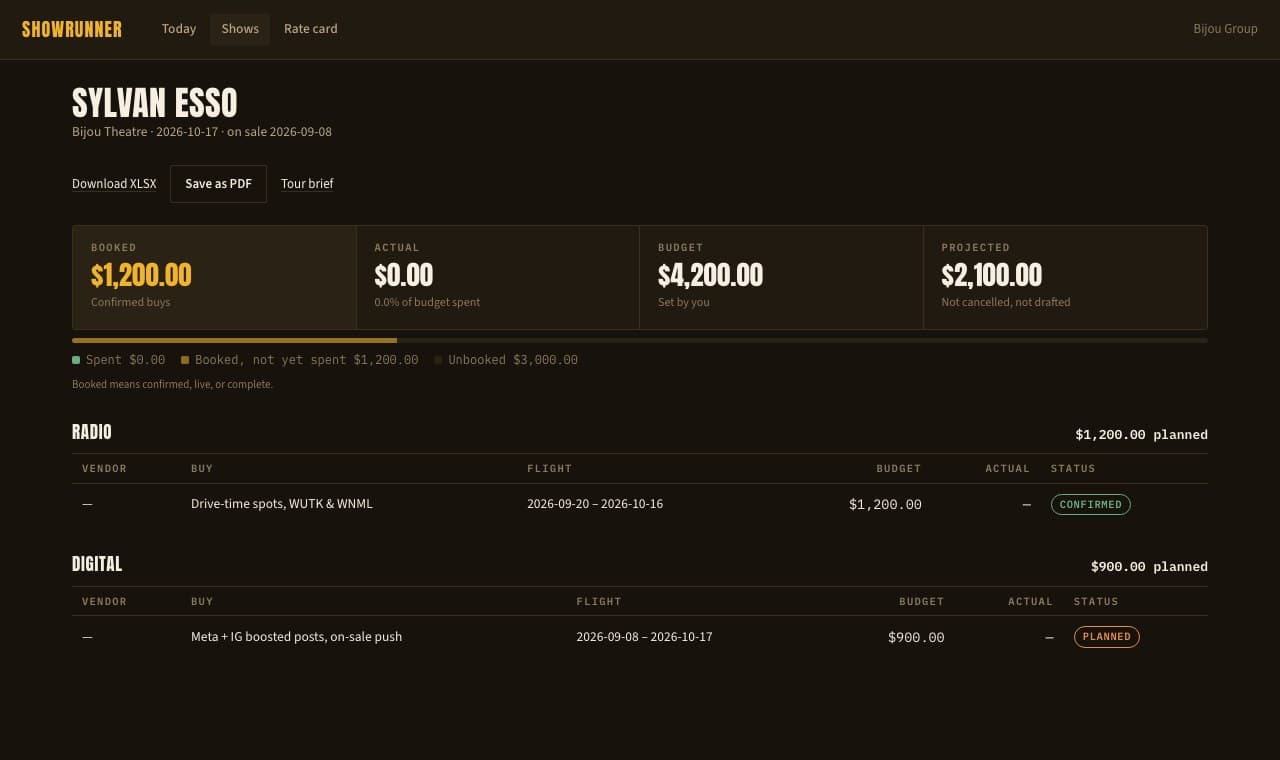
Tour emails and agency documents are ingested and their brief data extracted automatically, instead of a manager retyping it into a spreadsheet.
- 3
Marquee design system
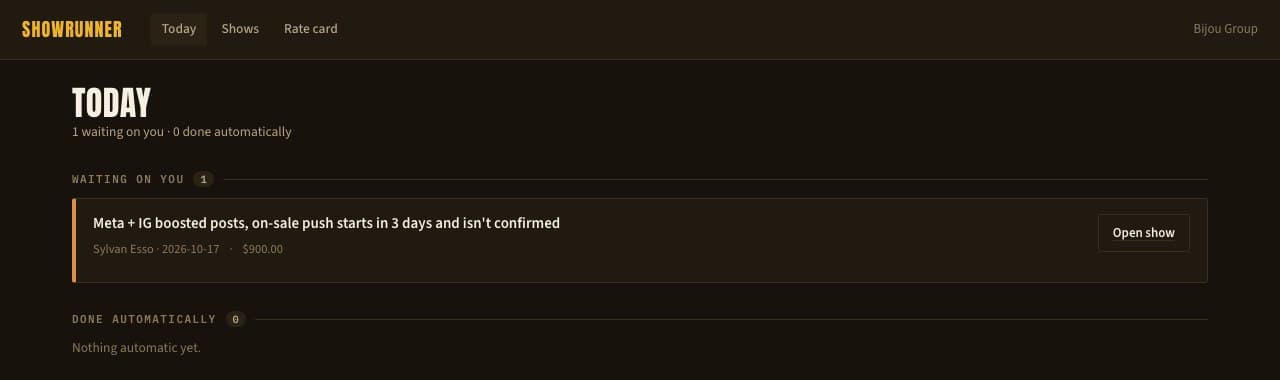
A dark-only screen palette plus a separate print palette, where the one amber accent means exactly one thing across the whole product: a person must act.
- 4
/today work queue
A cross-source queue of everything that needs a person — a rate-card disagreement and a brief conflict queue together, because they are the same job to whoever clears them.
- 5
Rate-card & affinity join
Vendor rate cards join against show and channel data so a placement’s cost is checked against what it should cost, not just recorded.
What it produced
The numbers, from one run
Shipped
Foundation
Multi-tenant orgs, venues, shows, channels
Shipped
Brief intake & extraction
Tour emails and agency documents, parsed automatically
Shipped
Marquee design system
Dark-only screen palette, separate print palette
Shipped
/today work queue
One cross-source queue of what needs a person
Shipped
Rate-card & affinity join
Placement cost checked, not just recorded
Next
AI drafter
The next build — not started
The real product
Not a mockup
What this means for a business like yours
The spreadsheet a venue’s marketing manager rebuilds every show is an output, not an input — hand-aggregated from tour emails, Drive folders and agency documents that all update on their own schedule. ShowRunner automates that aggregation, so the spreadsheet becomes a view over live data instead of the thing someone has to keep current by hand. Email still goes out from the venue’s own verified domain, not a ShowRunner subdomain.
What we did not measure
The AI drafter — the part that would turn intake into a proposed plan — does not exist yet; it is the next build, not this one. No venue runs ShowRunner in production today, so there is no measured outcome to report, only what shipped: foundation, brief intake and extraction, the Marquee design system, /today, and the rate-card/affinity join.